
Hydraulic System Design for Mobile and Industrial Machines
A well-engineered hydraulic system starts with a clear definition of the machine’s purpose, duty cycle, and environment. The following article presents a practical design framework covering application definition, pump and control selection, speeds and loads, load-hold and torque demands, manifold and hose considerations, and strategies for space and weight reduction you can use immediately when specifying systems for mobile or industrial equipment.
Clarifying the Application and Requirements
- Machine function and duty cycle: primary tasks; intermittent vs continuous operation; expected daily runtime.
- Actuators and motions: number and type of cylinders or motors; stroke lengths; rotation speeds; required positioning accuracy.
- Multiple movements
- Load characteristics: Force & Torque, steady loads, peak loads, dynamic impacts, shock loading, required h old times.
- Performance targets: desired linear speeds, rotational speeds, acceleration, deceleration, and repeatability.
- Environment: mobile or fixed; ambient temperature range; dust, water exposure, corrosive conditions, vibration.
- Power availability: available prime mover (engine or electric motor), and electrical system limits (voltage, phase, max current).
- Weight and space limits: envelope available for pump, reservoir, valves, and manifolds; acceptable mass budget.
- Safety and compliance: any statutory, OEM, or industry standards that must be met.
- Control preference and constraints: manual levers, electrical proportional/servo, CANbus/PLC integration, operator ergonomics.
- Serviceability and maintenance intervals: filter change access, hose routing service loops, diagnostic ports.
Pump and Prime Mover Selection
Choose pump type and size to meet flow, pressure and efficiency needs while matching the prime mover.Prime mover matching Energy-efficient options
- Pump types and when to use them
- Variable-displacement axial-piston pumps (pressure-compensated or load-sensing): best for variable flow demands and better fuel/electric efficiency; preferred for mobile machines with diverse tasks.
- Sizing rule of thumb
- Size pump flow (L/min or gpm) to meet required actuator speed at rated pressure with margin for control throttling and losses. Allow a 10–25% flow margin for unforeseen transient demands.
- Size pump pressure rating above maximum system pressure with safety margin (commonly 1.25× working pressure) and ensure relief valve set appropriately.
- Fixed-displacement gear pumps: simple, robust, low cost; use when flow and speed are roughly constant and load-holding is handled by valves or mechanical locks.
- For internal combustion engines, match pump displacement to engine speed band where torque and fuel efficiency are optimal. Use gear or transmission PTO options where available.
- For electric motors, consider variable-frequency drives (VFDs) to modulate pump speed and conserve energy when demand is low.
- Load-sensing systems: reduce wasted flow and improve fuel/electric consumption in variable-load applications.
- Variable-speed drives: reduce heat generation and improve efficiency in industrial fixed installations.
Controls, Speeds, and Load-Hold Function
Control architecture determines responsiveness, accuracy, and operator experience.
- Control types
- Manual spool valves: simple, low-cost, reliable; suitable for basic, low-precision tasks or where operator feel is important.
- Hydraulic-proportional valves: provide variable flow/pressure control with electrical command; good mid-level precision.
- Electro-hydraulic servo valves and closed-loop systems: required for high precision, fast response, and coordinated multi-axis motion.
- PLC/CANbus integration: for automated sequences, diagnostics, and remote monitoring.
- Speed control strategies
- Use valve sizing and flow-sharing or priority circuits to maintain desired actuator speeds under varying loads.
- For multiple simultaneous functions, consider flow dividers or priority valves to guarantee critical function speed.
- Combine variable-displacement pumps with electronic controls for smoother and more efficient speed control across workloads.
- Load-hold and safety
- For holding loads, use load-holding valves (counterbalance, pilot-operated check valves) sized to prevent creep under expected leakage.
- Where safety or long-duration hold is needed, incorporate mechanical locks or secondary locking devices to remove reliance on continuous hydraulic pressure.
- Anti-cavitation and bleed-off paths: design to avoid actuator drop when pressure falls; include pilot lines and sequence logic for safe lowering.
- Turning torque and motors
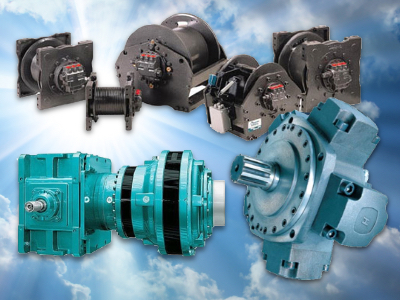
- For hydraulic motors, calculate required torque from load and gear reduction; ensure motor peak torque and continuous torque ratings are adequate.
- Include torque-limiting protection (pressure reliefs, torque limiters) to prevent overload or damage to drivetrain.
Manifold and Valve Block Design
A well-designed manifold reduces plumbing complexity, leak points, and packaged weight while improving reliability.
- Principles
- Integrate multiple valve functions into a single manifold to minimize fittings and hoses; place pilot and drain galleries for compact routing.
- Standardize porting sizes and use common mounting patterns for ease of sourcing and future servicing.
- Porting and flow paths
- Minimize flow path length and abrupt changes in cross-section to reduce pressure drop and turbulence.
- Place high-flow passages with generous cross-sections and ensure proper sealing for pilot lines and drain galleries.
- Thermal and pressure considerations
- Provide heat dissipation surfaces or mount manifolds on structural members that can act as heat sinks where heat removal is needed.
- Consider manifold material selection (aluminum for weight, steel for high-pressure, or coated alloys for corrosion resistance).
- Modularity
- Design manifold sections as modular cartridges to allow swapping or upgrading control functions without whole-system teardown.
- Include diagnostic ports and pressure tap locations for instrumenting during commissioning and maintenance.
Hose, Tubing, Space and Weight Reduction
Routing and component selection significantly affect reliability and ergonomics, particularly in mobile equipment.
- Hose vs tube
- Use high-pressure hoses with appropriate reinforcement where flexibility and movement are required. Select hoses rated for system pressure plus transient spikes and for temperature range.
- Use rigid tubing in static runs to reduce bulk and chafe; prefer flared or brazed connections in industrial builds for leak resistance.
- Weight and space strategies
- Integrate manifolds and combine low-pressure return lines into common harnesses; use compact pump-motor assemblies with integrated reservoirs.
- Use lighter materials (aluminum manifolds, composite reservoirs) where corrosion resistance and reduced mass are priorities.
- Place heavy items low and central to optimise machine stability in mobile applications.
- Leak mitigation
- Reduce leak points by consolidating connections in manifolds and using O-ring face seals or flanged connections in high-pressure locations.
Safety, Commissioning and Maintenance
A design that’s hard to service or unsafe in the real world fails in practice.
- Safety systems
- Relief valves for every pressure circuit, emergency stop hydraulic isolation, and properly sized return-line filters to avoid contamination failures.
- Include pressure indication and overpressure protection in both pilot and main circuits.
- Commissioning
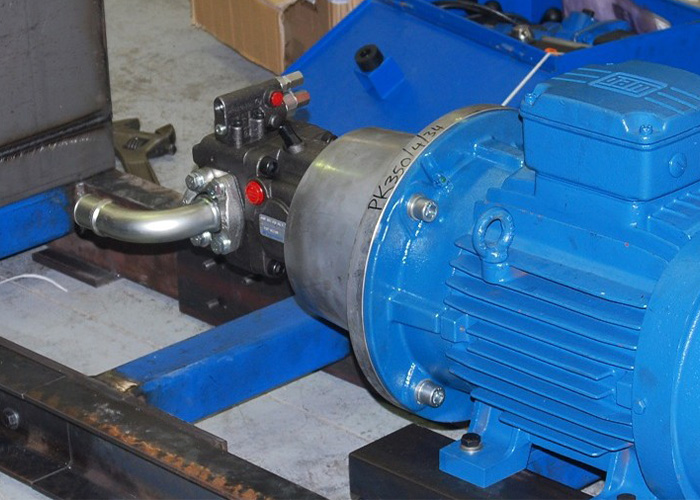
- Commission pump displacement, relief settings, and control gains on a test rig replicating real loads. Verify load-hold, thermal rise, and leakage under worst-case duty cycles.
- Validate anti-cavitation behavior at low speed and under rapid lowering.
- Maintenance considerations
- Fit accessible filter housings with differential pressure indicators and replaceable elements sized to the contamination protocol.
- Design service panels and hose access so common wear items can be replaced without removing major assemblies.